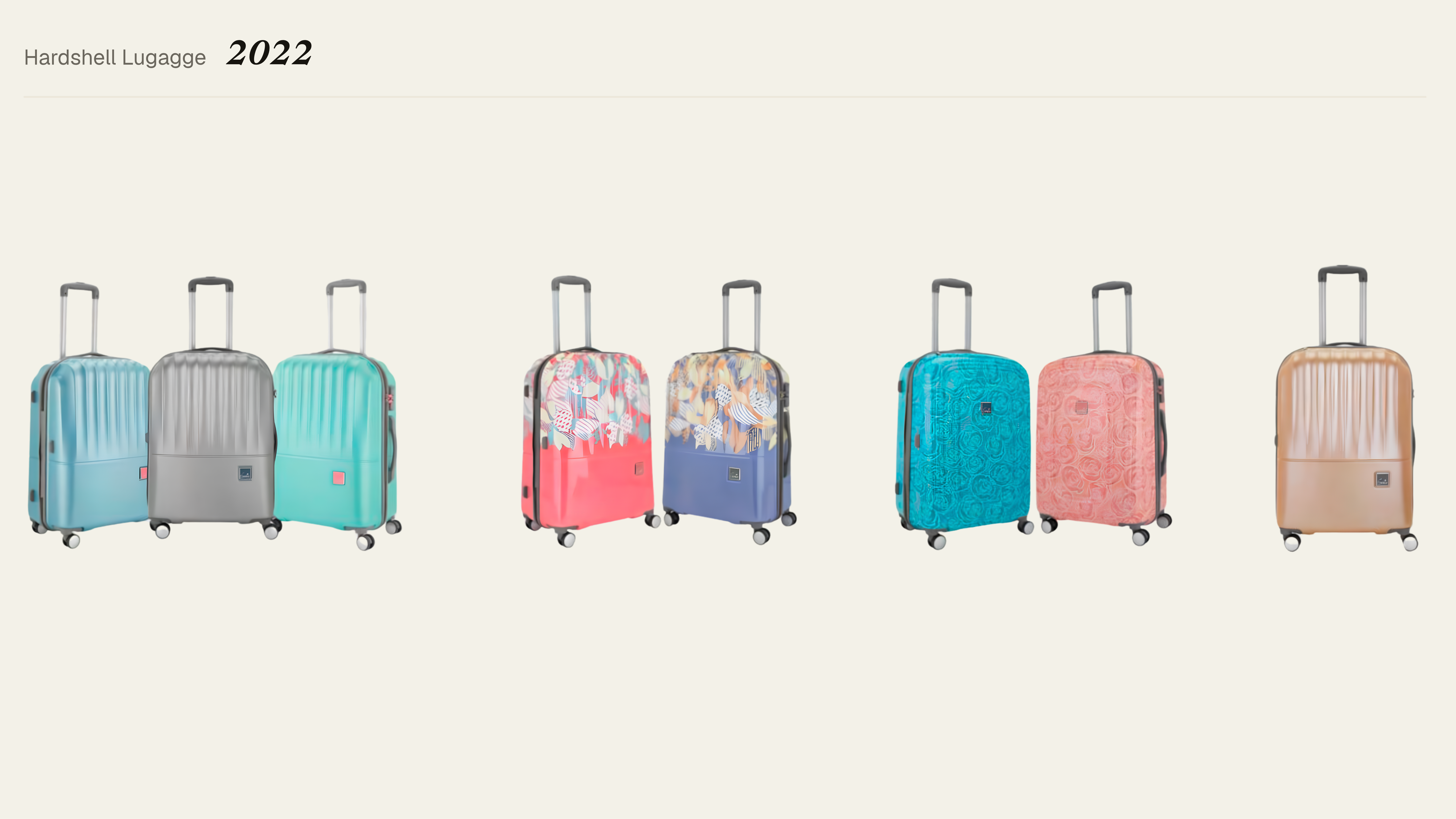
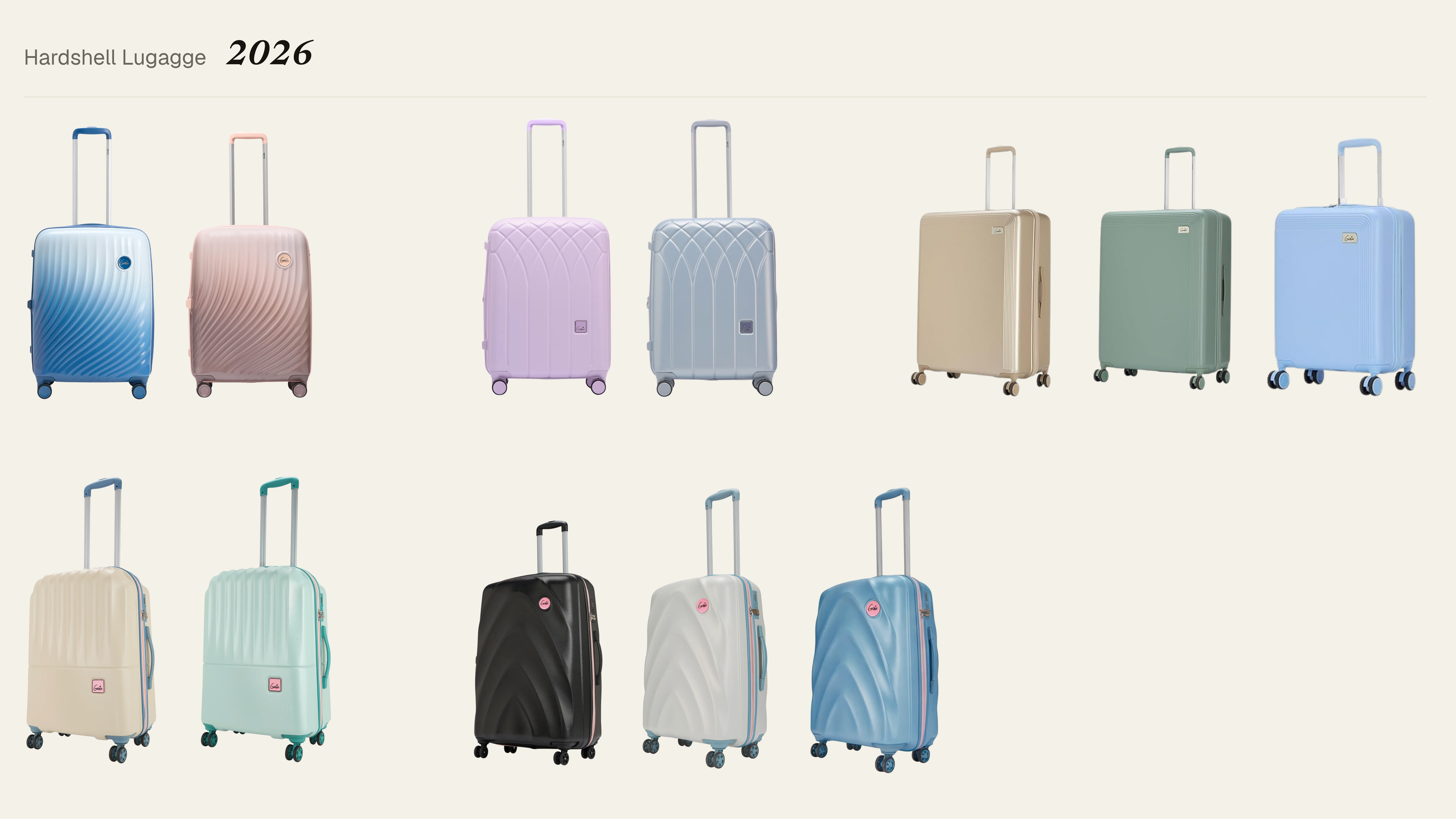
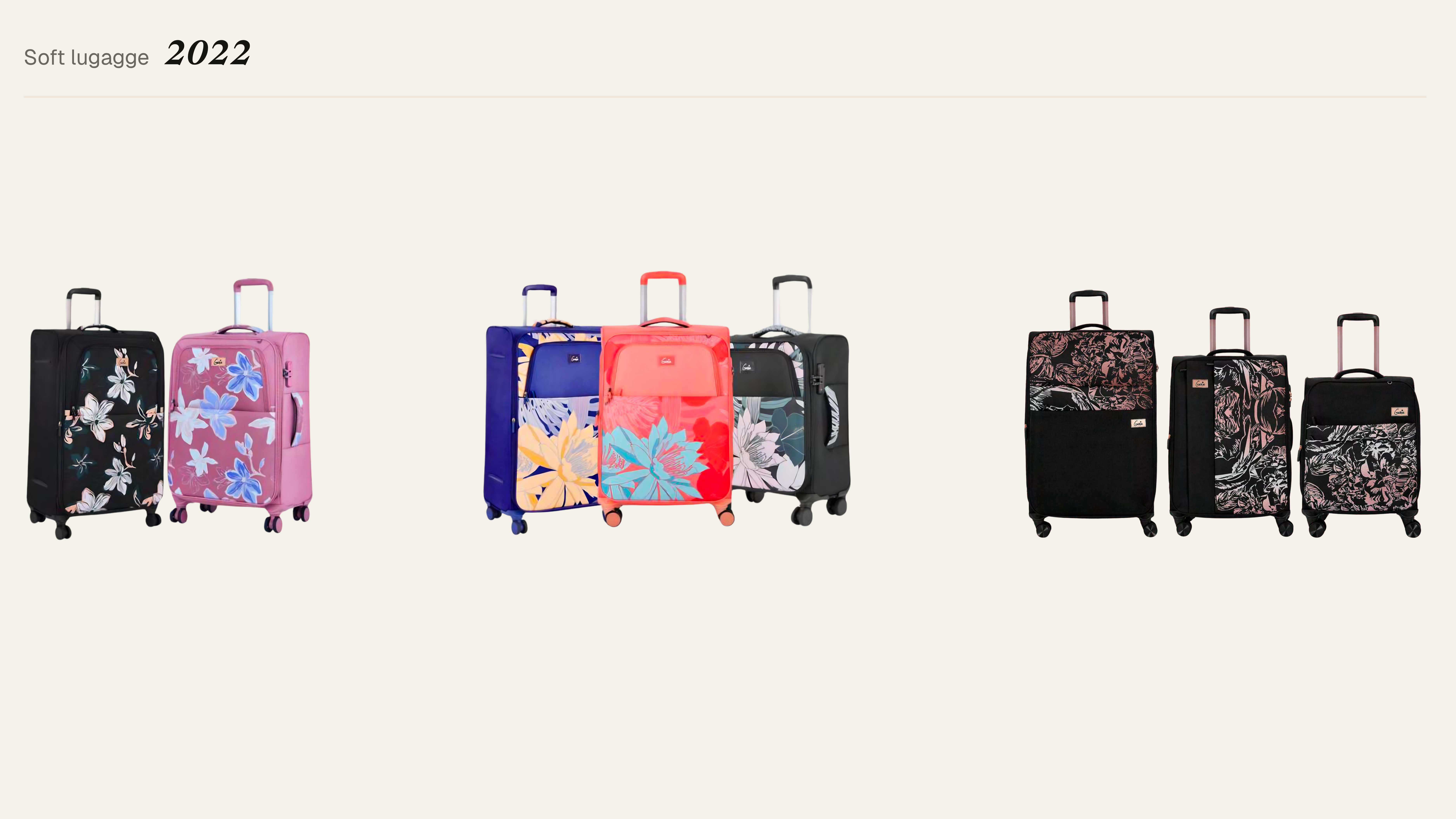
Luggage was one of the first things I did at Genie — before I rebuilt the backpack range, before the Korean call, before the operating system. The brand had committed to a luggage launch, and the brief came in as two ladders. Hard luggage ran three price points: Palm at value entry, Sprout and Rose (both at the same price point) through the mid-tier, Glam at the top. Soft luggage ran three: Lily at entry, Bahamas in the middle, Hazel at premium. The question was the same in both — what Genie's design language looked like in a category it had never been in.
I analysed the brand on arrival and made the translation call: take what made Genie Genie — its visual sensibility, its feminine-led identity, its print-led design language — and carry it into luggage. The forms came in collaboration with another designer; my work was the design direction, the CMF, and the brand-coherence call across the four ranges. Among India's branded luggage players, we were the first to put deliberate feminine prints on shelf.
The brand didn't have the budget or timeline to do formal consumer research before launch. So we did the next-best thing: we shipped what we believed in and used the market itself as the research instrument. Some of the printed ranges sold exceptionally — proof that the brand's identity travelled. But the niche turned out to be smaller than we'd hoped, and the volumes didn't scale to where we needed them.
So we calibrated. Heavy prints made way for ombres, glitter films, texture plays — the same brand sensibility, said more quietly. The brand could still be read as Genie at twenty paces; the addressable market widened. That recalibration carried through Scarlette, Diana, the later Palm work in 2026.
01PalmValue entrySolid polycarbonate with a twill texture and glossy finish; twin-side packing, fixed combination lock. The plain-shell entry into the category.
02Sprout & RoseMid-tierPrinted polycarbonate films over twin-side packing and premium grey components; Rose carried the volume on a maximum-capacity shell. The backbone of the hard range.
03GlamTop of hardGold semi-matte glitter film, TSA lock, multi-pocket interior. The aspirational ceiling that anchored the range upward.
01LilyEntryFull-body premium fabric, floral print, colour-matched components, expander, twin external pockets. The entry into soft.
02BahamasMidSteps up with a TSA lock and a footwear-storage interior, on the same full-body premium fabric. The volume middle of the soft ladder.
03HazelPremiumAnti-theft zipper, rose-gold detailing on colour-matched components, premium dual wheels, full-body premium fabric. Top of soft.
08aReading the signal.
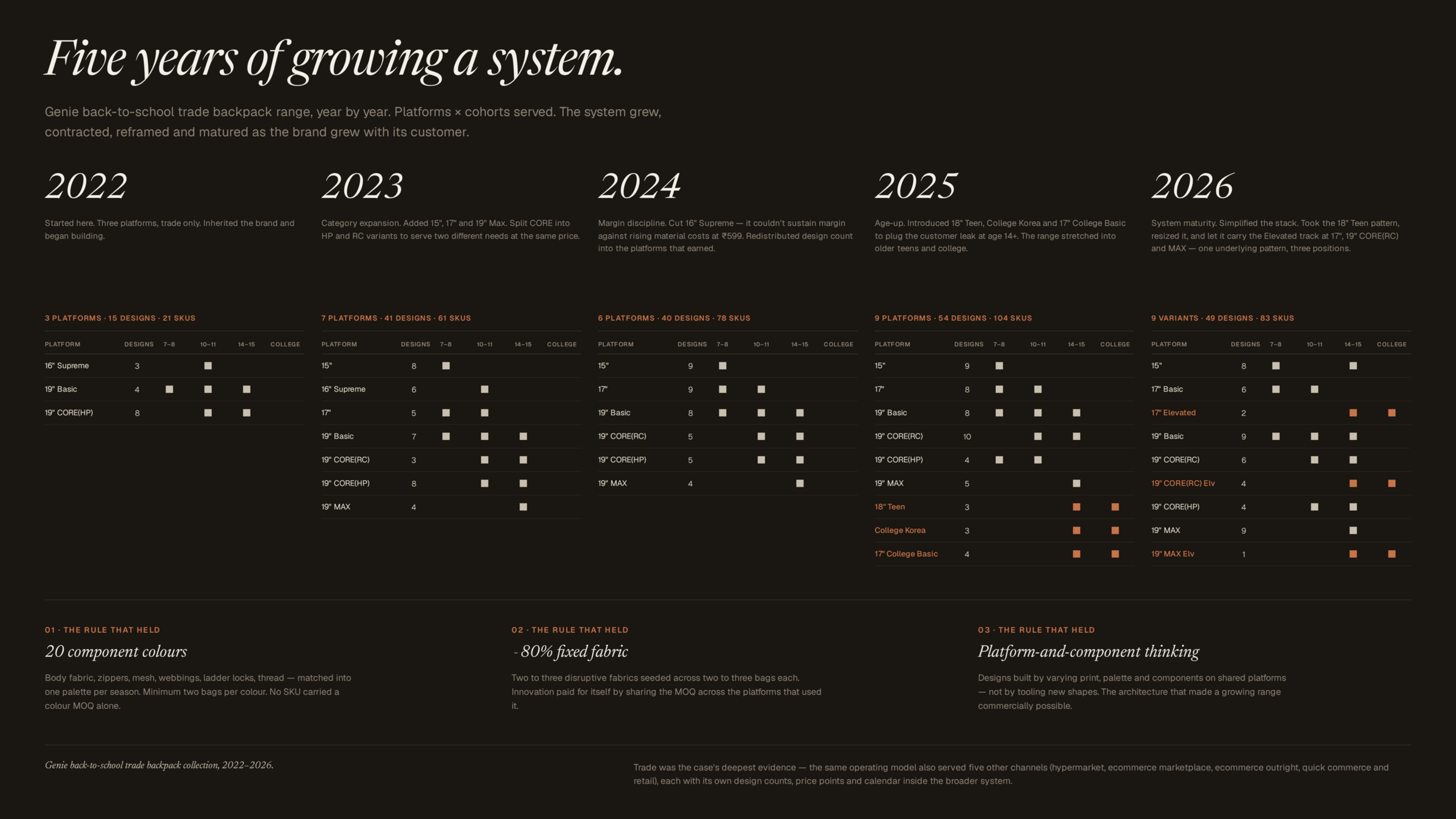
Heavy prints proved the language travelled — but the niche was small, and from there the two formats diverged. Hard luggage recalibrated: the same sensibility through ombrés and texture plays, widening the market without losing the brand. Soft went the other way — as the Indian market moved decisively to hardside, softside demand thinned, so we wound the soft ladder down rather than refresh a declining category. A managed exit, the same logic that retired Supreme on the backpack side. The read of the market told us what to do next.
08bSourced and adapted — the white-label extension.
Not every category-expansion move had to start from scratch. For Genie's push into work and professional categories — backpacks, satchels, totes — I sourced and customised designs from third-party manufacturers. I inherited their construction, platform and fabrics; my work was the colour, branding and small-feature adaptations that made each piece read as Genie.
This was a deliberate commercial decision, not a shortcut. Developing a new construction from scratch costs months of factory time the calendar didn't have. Sourcing and adapting let us bring newness to the work and professional range in weeks rather than seasons — cost-effective expansion without diluting the original-design programme running on the school and college sides.
It also clarified what's worth designing from scratch and what isn't. The school and college backpack ranges — where the brand identity lives and the cohort relationship is strongest — justified original construction development. The work and professional pieces, where customer expectation is "brand-appropriate variation of a familiar category" rather than "category-defining design," didn't.